The Statesman's Affidavit
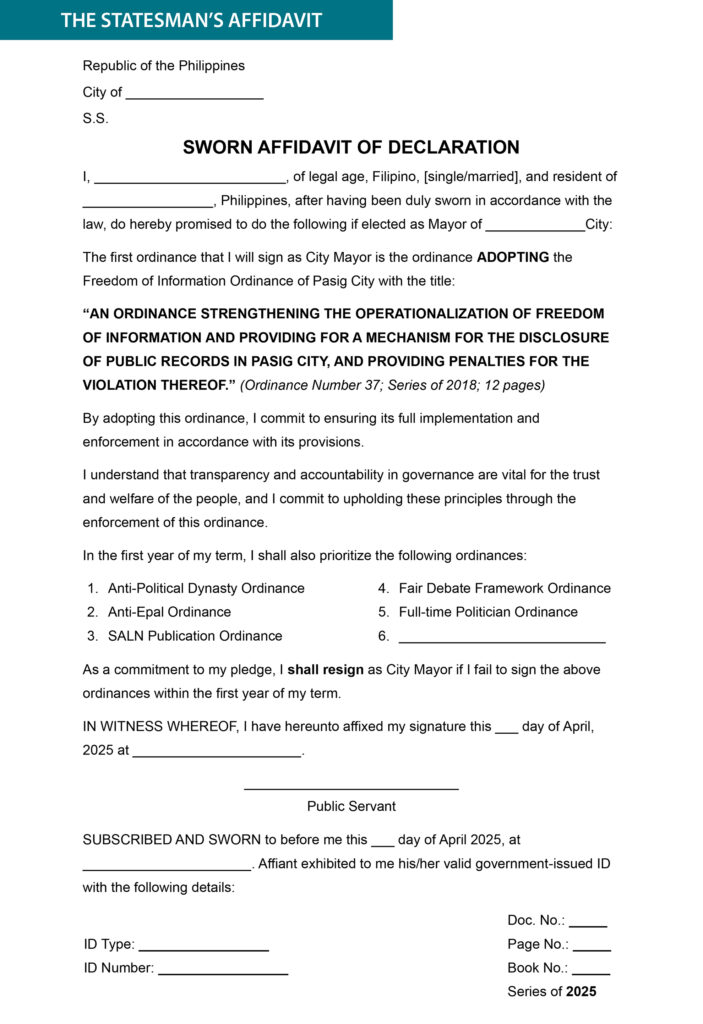
The Statesman’s Affidavit (2025) is a one-page notarized public declaration wherein political candidates commit to specific legislative priorities and accept voluntary resignation as a penalty for failure to deliver. Designed as a modern social contract, it aims to institutionalize electoral accountability and restore public trust in democratic leadership.
Anti-Political Dynasty Ordinance and Anti-Epal Ordinance are self explanatory. Anti-Epal Ordinance already exists in Pasig City.
- SALN Publication Ordinance – An ordinance requiring the publication of SALN, with redacted critical information. Since it’s still debated whether it should be public or not, then just redact some critical information that is against the right to privacy of the public official.
- Fair Debate Framework Ordinance – An ordinance institutionalizing the “City Mayor Fair Debate Framework with Questions from the Filipino Citizens”. https://zenodo.org/records/15233234
- Full-time Politician Ordinance – An ordinance requiring all politicians to work full-time from 8am to 5pm, Monday to Friday, with maximum number of vacation and sick leave like any other public official or private employee.
The Statesman’s Affidavit is a public domain tool – free to adopt, free to share, and binding only on those who truly serve.
A contract has three important elements: a promise, an obligation, and a penalty.
A sworn affidavit, even though it is not a contract, can be used by any good politician to build trust and win votes.
- A promise made during the campaign period.
- An obligation to fulfill that promise.
- A penalty in case the politician fails to deliver.
Benigno Aquino III promised to pass the Freedom of Information Bill into Law during the campaign period. However, after elected as President, he failed to prioritize the bill for six consecutive years.
Corruption has become the norm among many politicians. Good people become bad due to the lack of a transparency mechanism. Even the Vice President proudly announced in public:
“Napakaliit na amount ang P150 million. So bakit kami magnanakaw ng P150 million? Ang nakawan sa gobyerno ay bilyon-bilyon.”
(P150 million is a very small amount. So why would we steal P150 million?Corruption in the government involves billions.)
There are 149 cities and 89 provinces in the Philippines. If each of them had a Freedom of Information Ordinance (or Local Law) with a penalty provision, it would be a powerful tool against corruption in the entire Philippines.
In 2018, Mayor Vico Sotto introduced a local FOI law in Pasig City with penalties:
- 1st Offense: Reprimand
- 2nd Offense: Suspension of five (5) to thirty (30) days
- 3rd Offense: Dismissal from service
“May ngipin ang lokal na batas.”
Any local public official can be dismissed from office and lose their job if they fail to provide the requested document to the public.
Without corruption, we can have more funding for education, health, and other public services. All Filipinos can go to school without financial difficulties due to scholarships, and everyone can get the medical treatment they need without waiting for months or years.
This affidavit is an experiment, but one worth trying.
If it does not work, life moves on.
“Mabubudol na naman ang taumbayan ng mga politicians with empty promises.”
But if it does work, it could be an unorthodox solution for passing the Freedom of Information Ordinance and other landmark laws in many cities and provinces.
“We can either accept deception as normal, or we can try something new.”
—
The question to all Mayor and Governor Aspirants:
Will you sign this document in five seconds?
I can sign a document like this in five seconds. You can sign a document like this in five seconds. A good politician, to end broken promises, can sign a document like this in five seconds.
Even a blind Filipino, after hearing the FOI Ordinance of Mayor Vico Sotto, can sign this document in five seconds.
As a responsible Filipinos, we must demand from all politicians the highest standard of public service, transparency, and real accountability.
Elections only happen every three years. And there is a 45-day campaign period to sign a document like this in five seconds.
Kindly tag or send this document to any Mayor and Governor candidate. A wise person will act upon it. Integrity begins with a signature.
The future is ours to change. Let us start now.
Ipanalo natin ang Pilipinas !!!
The Statesman's Affidavit (2025) - Chapter 1 and 2 Working Paper
The Philippine electoral system continues to suffer from political dynasties, corruption, and a lack of enforceable accountability mechanisms. Campaign promises often lack follow-through, weakening democratic institutions and voter trust. In response, this paper introduces The Statesman’s Affidavit (2025), a one-page, voluntary, and notarized document that binds candidates to measurable campaign promises, including a self-imposed penalty clause. Operating outside legislative mandates, the affidavit converts rhetoric into enforceable moral commitments through civil notarization and public transparency.
The paper examines its theoretical foundations and reform potential, comparing it to classical political principles such as social contract theory. The affidavit represents a citizen-led solution to pre-election accountability. Although it originated in the Philippines, it offers a scalable and globally applicable model for democratic reform, reframing campaign promises as both moral and civic obligations to empower voters before a single vote is cast.
Other Published Works:
The Great Nation 2025
A citizen-driven legislative blueprint introducing over 75 original policy proposals addressing systemic challenges in education, healthcare, corruption, political dynasties, and governance transparency.
City Mayor Fair Debate Framework
A proposed model for structured, transparent, and accessible mayoral debates to strengthen civic participation and accountability in local elections.
Proposed Framework: Philippines Initiative Against Corruption (PIAC)
The Philippines Initiative Against Corruption (PIAC) is a citizen-driven framework to promote transparency and accountability in public infrastructure projects. It introduces a presumption of accountability for politicians, engineers and contractors involved in substandard or overpriced projects, while empowering citizens to report anomalies through social media. A centralized digital archive will support investigations and strengthen public oversight.